
If you have seen people searching for Google Nano Banana, Google Banana, or Nano Banana AI, you are not alone. The nickname is much easier to remember than Google's formal Gemini image model names, and that is why it keeps showing up in search.
The simple version: Google Nano Banana is the nickname people use for Google's AI image generation and editing models in the Gemini family. The name started around Gemini 2.5 Flash Image, then expanded into Nano Banana Pro and Nano Banana 2. If you want to test a live version on this site, you can jump to Nano Banana Pro or use the broader AI image generator.
Quick answer
Google Nano Banana is the widely used nickname for Google's AI image generation and editing models in Gemini. People search for it because the nickname is memorable, the model family keeps expanding, and the tools support both image creation and image editing.
Key takeaways
- Nano Banana started as Google's nickname for Gemini 2.5 Flash Image.
- Nano Banana Pro is positioned as the more advanced version with stronger creative control, better text rendering, and higher-fidelity outputs.
- Nano Banana 2 is framed as a newer model that mixes advanced capabilities with Flash-like speed.
- People search for Google Banana because the nickname is shorter and easier to remember than Google's formal model names.
What is Google Nano Banana?
Google Nano Banana is the name people use for Google's newer AI image generation and editing technology inside Gemini.
The nickname became official enough to stick when Google launched Gemini 2.5 Flash Image and described it as aka nano-banana. Google framed the model around blending multiple images, preserving character consistency, making targeted edits with natural language, and using Gemini's world knowledge to improve generation and editing.
Why do people call it Google Banana?
Because it is easier to remember.
Names like Gemini 2.5 Flash Image and Gemini 3 Pro Image are accurate, but they are not sticky. Nano Banana is short, weird, and memorable. Once Google used the nickname in official posts, it naturally expanded into search phrases like Google Banana, Google Nano Banana AI, and Nano Banana Google.
Why is Nano Banana getting so much attention?
Three reasons explain most of the interest.
It handles both generation and editing
Google positioned it as more than a text-to-image tool. It can blend references, preserve a subject, and make targeted edits with natural-language prompts.
It benefits from Gemini's reasoning
Google describes the newer versions around stronger reasoning, better creative control, and better text rendering for diagrams, posters, and other structured visuals.
The model family keeps expanding
The nickname now covers multiple versions, which makes people search the shorthand instead of memorizing Google's technical naming system.
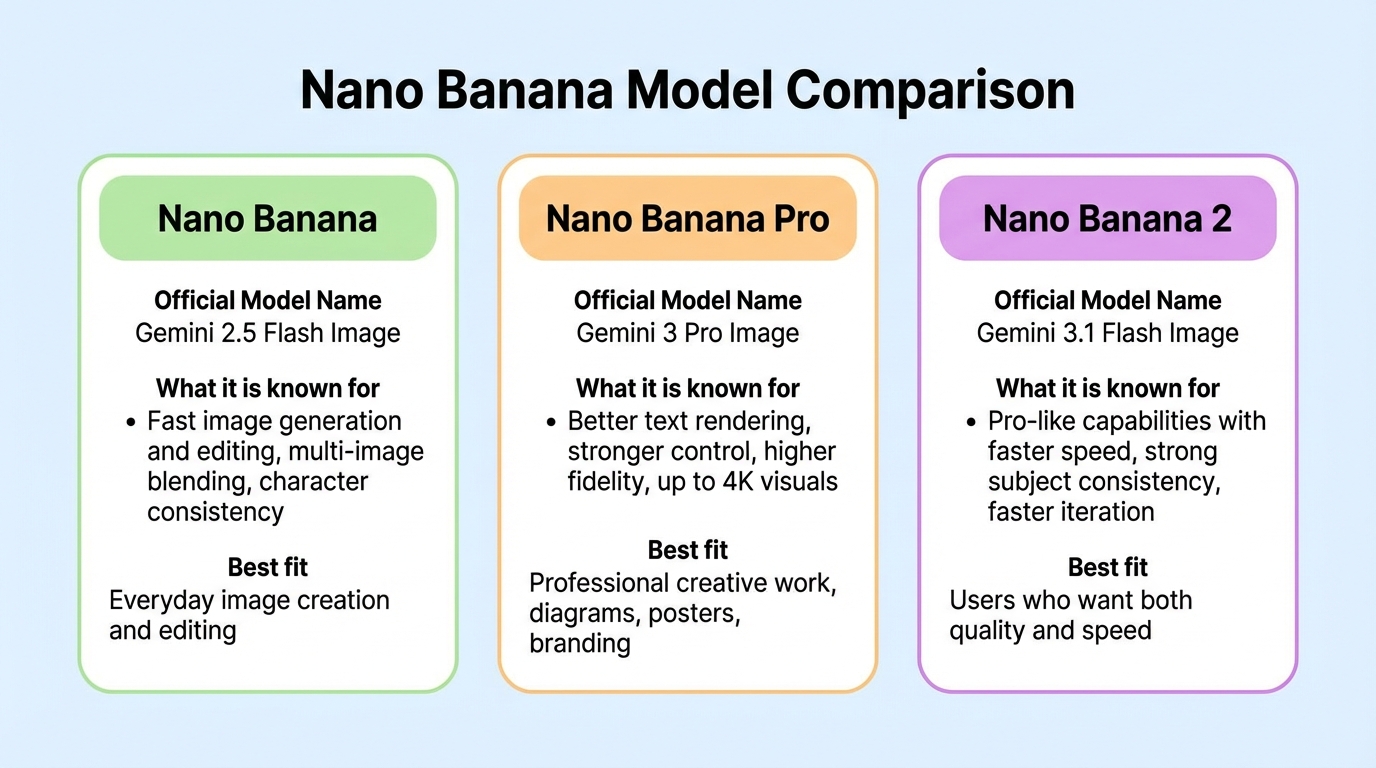
Nano Banana vs Nano Banana Pro vs Nano Banana 2
Here is the simple comparison.
| Model | Official model name | What it is known for | Best fit |
|---|---|---|---|
| Nano Banana | Gemini 2.5 Flash Image | Fast image generation and editing, multi-image blending, character consistency | Everyday image creation and editing |
| Nano Banana Pro | Gemini 3 Pro Image | Better text rendering, stronger control, higher fidelity, up to 4K visuals | Professional creative work, diagrams, posters, branding |
| Nano Banana 2 | Gemini 3.1 Flash Image | Pro-like capabilities with faster speed, strong subject consistency, faster iteration | Users who want both quality and speed |
In practice, the nickname now acts more like a family label than a single model label.
What can Google Nano Banana actually do?
From a user perspective, Nano Banana matters because it supports the visual tasks people actually want to do, not just single-shot image generation.
Google has also highlighted workflows such as animated GIF creation, virtual try-on style editing, and infinite-zoom-like creative upscaling. That makes Nano Banana feel less like a single-purpose image generator and more like a creative workflow tool. If you want a fast hands-on test, the AI image generator is the best general entry point on Lanta AI.
Where can people use Nano Banana?
Another reason people search this topic is simple: they want to know where it actually lives.
That means Nano Banana is not just a developer-only concept. It is increasingly part of Google's broader AI ecosystem.
Why are people searching for Google Nano Banana right now?
Most searchers are trying to answer one of these questions.
Is this a real Google product?
Yes. Google has used the nano-banana nickname in official announcements tied to Gemini image releases.
Which version does the nickname refer to?
That depends on context. Some people mean the original Nano Banana, while others mean Nano Banana Pro or Nano Banana 2.
Is it better than other AI image tools?
That depends on what you need, but Google positions the newer versions around better editing, prompt understanding, text rendering, and more production-friendly outputs.
Where can I try something similar?
You can try Nano Banana Pro on Lanta AI for a dedicated model page, or open the broader AI image generator if you want multiple image engines in one workflow.
Why this matters for creators
For creators, Nano Banana matters because it reflects a bigger shift in AI content creation.
Older workflow
Write one prompt, generate one image, retry if it fails.
Newer workflow
Upload references, edit precisely, preserve consistency, and refine over multiple steps.
Final thoughts
Google Nano Banana is the nickname for Google's AI image generation and editing model family in Gemini. It started with Gemini 2.5 Flash Image, expanded with Nano Banana Pro, and continued with Nano Banana 2.
People keep searching for it because the nickname is memorable, the model family is evolving quickly, and the tools now cover much more than simple image generation.
Google Banana is not a random meme term.
It has become shorthand for one of Google's most visible AI image model lines.
Frequently Asked Questions
Want to explore more AI creative workflows?
Start with the dedicated Nano Banana Pro page, or use the broader AI image generator if you want multiple image engines in one workflow.